

Four Forces of Flight: 4 Forces Explained
How airplanes fly is one of the most common questions asked by people who are interested in aviation.
Even people who are not directly interested in the aviation industry often wonder how such large machines can stay in the air.
Let’s explain this subject in a simple but technically meaningful way.
Airplanes are among the most important transportation vehicles of the modern world.
Every day, thousands of aircraft carry hundreds of thousands of people safely and quickly to different destinations.
However, many people do not know the basic principles that make flight possible.
In this article, we will examine the basic components of an airplane, the main principles of flight, and the Four Forces of Flight that act on an aircraft during operation.
The aim is not to turn the subject into a university-level aerodynamics lecture.
The aim is to make the basic logic clear enough so that the next time you see a passenger aircraft taking off, you do not simply think, “Big metal bird goes brrr.”
Basic Components of Airplanes
I previously explained the main sections of airplanes in this article >>>.
The shortest summary is this: airplanes are large and complex machines made of many systems that work together.
In a simplified explanation, an aircraft can be discussed through three essential parts: the fuselage, the wings, and the power unit.
The fuselage contains the passenger cabin, cargo areas, cockpit, and many internal systems.
It also affects the aircraft’s weight distribution and structural balance.
The wings are the most important components for keeping the aircraft in the air.
They create the pressure differences and airflow changes that help produce lift.
The power unit provides the forward movement required for takeoff, climb, cruise, and other phases of flight.
In modern passenger aircraft, this power usually comes from jet engines.
These basic sections do not work separately.
The body, wings, engines, control surfaces, landing gear, electrical systems, hydraulic systems, and cockpit all support each other.
A safe flight is possible only when these systems operate together correctly.
Basic Principles of Flight
If you have ever watched an airplane take off or land from a close distance, the first thing you probably noticed was the noise.
Jet engines are much louder and more powerful than the engines used in many propeller aircraft.
This can create a common misunderstanding.
Many people assume that engines are the only reason airplanes fly.
Even some people working around aviation may fall into this simplified explanation from time to time.
If that idea were completely correct, we would have a hard time explaining how gliders or paper airplanes can fly without engines.
Engines are extremely important because they provide forward motion.
However, forward motion alone is not the full explanation.
To understand how airplanes stay in the air, we need to look at aerodynamics.
The basic principles include the Bernoulli principle, Newton’s laws of motion, airflow behavior around wings, and the control of rotational movement.
In a practical sense, an airplane flies because airflow around its wings and body creates forces that can overcome weight and control motion.
That is where lift, gravity, thrust, and drag enter the story.
Four Forces of Flight Acting on an Airplane
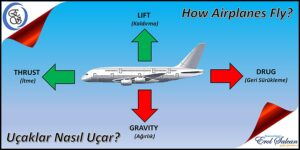
During flight, four main forces act on an aircraft.
These forces determine whether the airplane climbs, descends, accelerates, slows down, or maintains steady flight.
Understanding them is the easiest way to understand the basic physics of aviation.
-
1. Lift Force
Lift is the upward force acting on the aircraft.
It is mainly produced by the wings and their airfoil shape.
As air moves around the wing, pressure differences form between the upper and lower surfaces.
This pressure difference helps push the aircraft upward.
Lift must be strong enough to balance or overcome the aircraft’s weight for the airplane to stay in the air.
-
2. Gravity
Gravity is the downward force acting on the aircraft.
It is caused by the weight of the airplane, including its structure, fuel, passengers, cargo, and equipment.
During level flight, lift and gravity are generally balanced.
If lift becomes greater than weight, the aircraft can climb.
If weight becomes greater than lift, the aircraft descends.
-
3. Thrust Force
Thrust is the forward force that moves the aircraft through the air.
In passenger aircraft, thrust is generally produced by jet engines.
In propeller aircraft, it is produced by propellers driven by engines.
Thrust helps the aircraft accelerate on the runway, take off, climb, and maintain speed during cruise.
Without forward movement, the wings cannot create the airflow needed for normal flight.
-
4. Drag Force
Drag is the backward force that resists the aircraft’s movement through the air.
It is caused by air resistance and depends on factors such as aircraft shape, speed, surface condition, and configuration.
When an airplane extends flaps, landing gear, or spoilers, drag can increase.
This can be useful during landing because the aircraft needs to slow down safely.
However, too much drag during cruise reduces efficiency and increases fuel consumption.
In stable level flight, lift balances gravity and thrust balances drag.
During takeoff, climb, descent, turning, and landing, these forces change continuously.
Pilots and aircraft systems manage these changes through engine power, control surfaces, speed, attitude, and configuration.
Bernoulli Principle
[bs-quote quote=”The hydrostatic pressure of a continuously flowing fluid will be in an opposite balance with the fluid’s speed and height.
There is an inverse relationship between the speed and pressure of a fluid. In other words, where the speed of the fluid increases, pressure decreases; where the speed decreases, pressure increases.” style=”default” align=”left” color=”” author_name=”Daniel Bernoulli” author_job=”Mathematician” author_avatar=”https://erolsalcan.com/wp-content/uploads/2023/03/Daniel-Bernoulli.png” author_link=””][/bs-quote]
The Bernoulli principle states that when the speed of a fluid increases, its pressure decreases.
This principle is important for understanding airflow around airplane wings.
When an aircraft moves forward, air flows around the wing surfaces.
The shape and angle of the wing change the speed and pressure of this airflow.
Air moving over the upper surface can create a lower-pressure region compared with the air below the wing.
This pressure difference contributes to the upward force that helps support the aircraft.
However, Bernoulli’s principle alone should not be treated as the complete explanation of flight.
It is part of the explanation, but it does not tell the whole story.
Aircraft lift is also strongly connected to how wings deflect air downward and how Newton’s laws apply to airflow and motion.
So, if someone explains flight with only one sentence and then walks away confidently, be careful.
Aerodynamics has a habit of punishing oversimplified explanations.
Newton’s Laws of Motion
Newton’s laws of motion explain how objects move under the influence of force, mass, and acceleration.
These laws are also essential for understanding how airplanes fly.
An aircraft moves forward because engines produce thrust.
As the aircraft moves, the wings interact with the surrounding air.
The wing does not simply “sit” in the airflow.
It changes the direction and speed of the air passing around it.
When the wing deflects air downward, the air also exerts an upward reaction force on the wing.
This is related to Newton’s third law: for every action, there is an equal and opposite reaction.
In simple terms, the wing pushes air downward, and the air helps push the wing upward.
This does not replace the pressure-based explanation.
Both perspectives help explain the same physical event from different angles.
Takeoff and landing are also connected to these laws.
During takeoff, thrust accelerates the aircraft.
As speed increases, airflow over the wings becomes stronger and lift increases.
During landing, the aircraft reduces speed and manages lift, drag, and descent rate until it touches down safely.
Principles of Rotational Motion
Rotational motion is important because an aircraft must be controlled around three axes.
These movements are pitch, roll, and yaw.
Pitch is the nose-up or nose-down movement.
Roll is the movement where one wing goes up while the other goes down.
Yaw is the side-to-side movement of the aircraft’s nose.
Pilots control these movements using flight control surfaces.
Ailerons are used to control roll.
The elevator is used to control pitch.
The rudder is used to control yaw.
These surfaces change airflow around the aircraft and create forces that rotate the airplane around its axes.
This is what allows pilots to climb, descend, turn, correct alignment, and maintain stable flight.
Without controlled rotational movement, an aircraft would not be safely steerable.
It would be less “airplane” and more “very expensive uncontrolled projectile.”
How Airplanes Fly
[bs-quote quote=”The popular explanation of lift is widespread, quick, sounds logical, and gives the right answer, but it also leads to misunderstandings, uses an unsound physical argument, and misleadingly invokes Bernoulli’s equation.” style=”default” align=”left” color=”” author_name=”Prof. Holger Babinsky” author_job=”University of Cambridge” author_avatar=”https://erolsalcan.com/wp-content/uploads/2023/03/Prof-Holger-Babinsky.png” author_link=””][/bs-quote]
The flight of an airplane is made possible by the interaction between airflow, wing shape, pressure differences, downward deflection of air, engine thrust, and aircraft control.
Lift supports the aircraft against gravity.
Thrust moves it forward against drag.
When these forces are managed correctly, the airplane can take off, climb, cruise, descend, and land safely.
A common explanation says that air moving over the curved upper surface of a wing must travel a longer distance than air moving below it.
According to this explanation, the upper airflow must move faster, creating lower pressure above the wing and therefore lift.
This explanation is partly useful, but it is incomplete and can be misleading if presented as the whole truth.
If it were fully sufficient, it would be difficult to explain aerobatic flight, inverted flight, or aircraft with different wing shapes and flight attitudes.
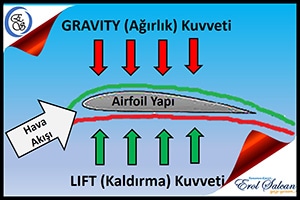
A more accurate explanation is that a curved airfoil changes the direction and behavior of the air during flight.
As an airplane moves forward, the curved upper part of the wing helps reduce pressure above the wing.
At the same time, airflow is affected below the wing as well.
As air flows over the curved upper surface, its natural tendency is to continue in a straighter path.
However, the shape of the wing guides the air downward and around the surface.
This changes the pressure distribution and contributes to lift.
The air below the wing can experience increased pressure because the advancing wing compresses and redirects air molecules.
As a result, a pressure difference forms between the upper and lower surfaces of the wing.
Wind tunnel experiments show that the speed difference between airflow above and below the wing can be much greater than the simple “equal transit time” explanation suggests.
If two air molecules separate at the front of the wing, the one moving over the upper surface does not have to meet the lower one at the trailing edge at the same time.
In reality, the upper airflow can arrive much earlier.
Both streams are influenced by the wing, and both can be accelerated downward.
This downward acceleration of air helps create the upward force needed for flight.
Aircraft speed, altitude, wing angle, and configuration all affect lift.
When speed increases, lift can also increase.
However, if the wing angle becomes too steep, airflow may separate from the wing surface.
This can reduce lift and may lead to a stall.
That is why angle of attack is extremely important in aviation.
Airplanes do not fly simply because they have engines.
They fly because wings interact with moving air in a controlled way, while engines provide the motion needed to maintain that airflow.
So the short version is this: engines move the aircraft forward, wings shape and redirect airflow, lift supports the aircraft, gravity pulls it down, drag resists motion, and pilots control the whole system.
Simple enough to understand, complex enough to keep aerospace engineers employed forever.
We can examine the subject in more detail in future articles.
Conclusion
The basic explanation of flight depends on airflow, pressure differences, Newton’s laws, engine thrust, and aircraft control.
The Four Forces of Flight help summarize the main physical effects acting on an airplane.
Lift acts upward, gravity acts downward, thrust acts forward, and drag acts backward.
For an aircraft to fly safely, these forces must be balanced and controlled during different phases of operation.
Bernoulli’s principle helps explain pressure changes around the wing, while Newton’s laws help explain how airflow deflection creates reaction forces.
Neither explanation should be used alone as the complete answer.
Aircraft flight is the result of several physical principles working together.
Understanding these basics is a good starting point for anyone interested in aviation, aircraft design, or flight mechanics.
Best regards.