

ChatGPT Questions: 16 Practical Answers
In my previous article about the Internet of Things, I mentioned artificial intelligence briefly.
Now, let’s examine one of the most popular artificial intelligence tools of recent years in a question-and-answer format.
ChatGPT Questions are useful because many people still wonder what this tool is, what it can do, what it cannot do, and how it should be used.
After all, if a system is described as an artificial intelligence language model, it should be able to answer basic questions about itself, right?
At least that is the idea.
For this reason, I prepared a simple interview-style article.
The aim is not to present artificial intelligence as magic.
The aim is to explain its strengths, limitations, possible use areas, and risks in a clear way.
You can visit the official page through the link below:
Visit the official ChatGPT page >>>
The answers below are written in a practical and updated way.
Some older claims about artificial intelligence tools can quickly become outdated because these systems continue to develop.
Therefore, it is better to understand the general logic instead of memorizing one fixed description forever.
Technology does not wait for us to finish our coffee.
It updates itself and then politely breaks half of yesterday’s explanation.
Why ChatGPT Questions Matter
ChatGPT Questions help users understand the tool before using it for writing, coding, research preparation, studying, or daily productivity.
Many people either overestimate artificial intelligence or underestimate it completely.
Both approaches are risky.
A better approach is to understand what the tool can support, where it may fail, and when human judgment is still necessary.
This article answers 16 common questions in a practical way.
1. What Is ChatGPT?
ChatGPT is an artificial intelligence-based service developed by OpenAI.
It is designed to understand user questions and instructions and produce helpful responses in natural language.
People can use it for many tasks such as writing, summarizing, brainstorming, translation support, coding help, studying, planning, and analyzing information.
In simple terms, it is a conversational assistant that can generate text-based answers according to the user’s request.
It does not think like a human being.
However, it can recognize patterns in language and produce responses that often feel natural and useful.
2. What Is It Not?
It is not an all-knowing source of truth.
It is not a human expert.
It is not a doctor, lawyer, engineer, teacher, programmer, or consultant by itself.
It can support these areas, but it should not replace qualified professional judgment in critical matters.
The system can make mistakes, misunderstand the question, provide outdated information, or sound confident even when the answer needs verification.
This is why important information should always be checked from reliable sources.
In other words, it is a powerful tool, not a digital oracle sitting on a golden chair.
3. Does It Know Everything?
No.
No artificial intelligence model knows everything.
It can answer many questions, but its answers depend on training, available tools, context, user instructions, and the quality of the question.
It may not know private information unless the user provides it or connects a relevant tool.
It may also need web access or an uploaded document to answer current or specific questions accurately.
For example, if a question is about current prices, new laws, recent news, software updates, or a newly published product, the answer should be verified with updated sources.
4. What Is Its Purpose?
Its main purpose is to help users work with language, information, ideas, and tasks more efficiently.
It can answer questions, explain concepts, generate drafts, summarize long texts, translate content, help with code, create plans, compare options, and support learning.
Among common ChatGPT Questions, this one is important because the tool is often misunderstood as either a search engine or a perfect expert.
In reality, it is better understood as an assistant that helps users structure, produce, review, and improve information-based work.
However, the quality of the output depends heavily on the prompt.
A vague request usually produces a vague answer.
A clear request usually produces a better result.
Yes, the old rule still survives: garbage in, garbage out.
Artificial intelligence just makes the garbage look more grammatically confident.
5. What Can It Be Used For?
It can be used in many everyday and professional tasks.
Examples include writing articles, preparing emails, creating summaries, explaining technical subjects, generating ideas, planning projects, translating text, editing content, preparing study notes, reviewing code, and creating basic software examples.
It can also help with data-related tasks when users provide structured files or clear information.
For example, it may help inspect data, create tables, explain patterns, or suggest charts when the output benefits from a structured view.
Still, users should review results carefully, especially in technical, legal, financial, medical, or academic work.
6. Can It Affect Jobs in the Future?
Yes, artificial intelligence tools can affect some jobs.
Repetitive writing, basic customer support, simple data processing, routine reporting, translation assistance, content drafting, and some coding tasks may become more automated.
This may reduce the need for some manual tasks.
However, it may also create new work opportunities.
People who learn how to use these tools effectively may become more productive.
New roles may appear around AI operations, prompt design, data quality, automation planning, model evaluation, ethics, security, and human-AI workflow management.
So the question is not only “Will jobs disappear?”
The better question is “Which tasks will change, and who will adapt fastest?”
7. What New Job Opportunities Can Appear?
Artificial intelligence technologies can create or expand several roles.
Some examples include:
- AI Specialist: Works on designing, evaluating, and improving AI-based systems.
- Data Analyst: Collects, cleans, interprets, and prepares data for decision-making or model use.
- AI DevOps / MLOps Specialist: Supports deployment, monitoring, maintenance, and operation of AI systems.
- Human-Machine Interaction Designer: Designs user-friendly interfaces and workflows for AI-supported systems.
- AI Ethics and Governance Specialist: Works on responsible use, bias control, risk management, policy, and compliance.
- Prompt and Workflow Designer: Builds reusable instructions and processes for more efficient AI use.
These are only a few examples.
As the technology develops, new roles and hybrid job descriptions may continue to appear.
8. Is It a Revolution?
It can be considered an important technological shift, especially in natural language processing and human-computer interaction.
This is one of the most debated ChatGPT Questions because the answer depends on how we define the word “revolution.”
For many people, it made artificial intelligence more accessible and easier to use.
Instead of requiring advanced technical knowledge, users can simply write a question or instruction in natural language.
This changed how people interact with digital tools.
However, calling it a revolution does not mean it is perfect.
It still needs human control, verification, ethical use, privacy awareness, and responsible implementation.
The tool is impressive, yes.
But impressive does not mean flawless.
A rocket is impressive too; you still do not point it at your living room.
9. Which Languages Can It Use?
The system can work with many languages, including Turkish.
However, response quality may vary depending on the language, topic, complexity, and available context.
It may perform better in some languages and technical areas than others.
For this reason, users should review important outputs carefully.
If the subject is highly technical or sensitive, it may be useful to compare the answer with reliable sources in the relevant language.
10. Does It Know Turkish?
Yes, it can understand and generate Turkish text.
It can translate, summarize, edit, explain, and create Turkish content.
However, Turkish outputs may still require review, especially when the subject includes technical terminology, legal language, medical information, aviation terms, or academic writing.
For example, literal translation may sometimes sound unnatural.
In such cases, the output should be edited for meaning, tone, and terminology.
This is especially important for professional content.
11. Is Its Information Always Current?
No.
This is one of the most important ChatGPT Questions, especially for people who use the tool for research, business, law, finance, software, or current events.
Its access to current information depends on the version, available tools, user settings, and whether web browsing or another live source is used.
Some answers may be based on previously learned patterns rather than current data.
Therefore, current topics should be checked from reliable and up-to-date sources.
This includes news, prices, laws, regulations, official rules, product features, software versions, schedules, and market information.
A good habit is simple: use the tool for explanation and structure, but verify time-sensitive facts.
Trust is good.
Verification is better.
Blind trust is how people end up confidently wrong in public.
12. Can It Say “I Do Not Know”?
Yes, it can say that it does not know something.
It can also ask for more context or explain uncertainty.
However, it may sometimes produce an answer even when the answer is incomplete or uncertain.
This is why users should pay attention to confidence, citations, and the quality of reasoning.
If the subject is important, users should ask for sources, request verification, or compare the answer with official information.
A careful user gets better results than a passive user.
13. Can It Write Code?
Yes, it can help write code in many programming languages.
It can generate examples, explain errors, suggest improvements, write small functions, outline project structures, and help debug simple problems.
It can also explain programming concepts in a beginner-friendly way.
However, generated code should always be tested.
It may include bugs, security issues, outdated methods, or missing edge cases.
For serious software projects, professional review and proper testing are necessary.
Code that “looks right” is not always right.
Software has a special talent for smiling politely before crashing in production.
14. Can It Develop a Software Program?
It can help plan and write parts of a software program.
It can assist with requirements, architecture ideas, database design, API examples, user interface drafts, test cases, documentation, and code snippets.
It can also help explain how different parts of a project should work together.
Still, building a complete and reliable software product requires more than generated text.
Developers must test, review, secure, refactor, deploy, monitor, and maintain the system.
For professional applications, human software engineering remains essential.
The tool can be a strong assistant, but it should not be treated as the entire development team.
15. Can It Write a Simple Code Block?
Yes.
This is one of the most practical ChatGPT Questions because many users first test the tool with simple coding examples.
For example, the following Python code prints “Hello World!” on the screen:
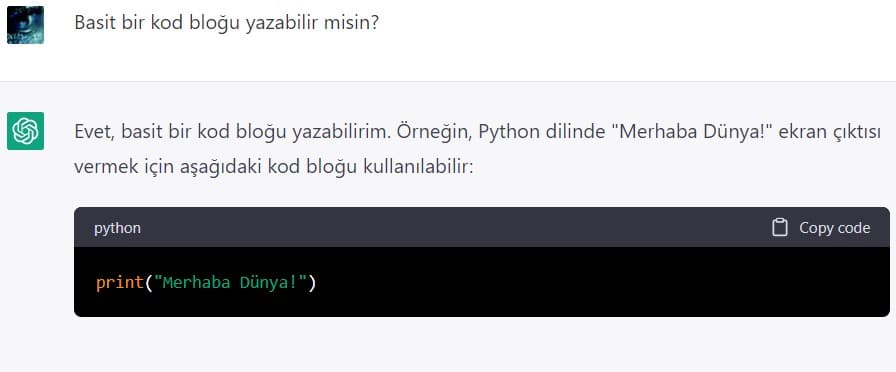
This is a very basic example.
More complex code can also be generated, but complexity increases the need for testing and review.
For example, database operations, authentication, payment systems, file processing, and API integrations should not be copied blindly without understanding the risks.
16. How Can It Be Used More Efficiently?
To get better answers, users should ask clear and specific questions.
For practical ChatGPT Questions, the best results usually come when the user explains the goal, context, constraints, expected format, tone, and important details.
For example, instead of writing “write about aviation,” a better request would be:
“Write a 1,000-word beginner-friendly article about aircraft maintenance documents, with short paragraphs, SEO title, meta description, and examples.”
This gives the system a much clearer target.
Useful tips include:
- Ask clear and direct questions.
- Provide enough context.
- Explain the expected output format.
- Use examples when possible.
- Ask for sources when factual accuracy matters.
- Review important answers instead of copying blindly.
- Break complex tasks into smaller steps.
- Ask follow-up questions when the first answer is not enough.
It is also important not to share sensitive personal data, passwords, private documents, or confidential business information unless the platform and account settings are appropriate for that use.
Users should understand privacy settings and data controls before using any AI service for sensitive work.
Final Thoughts
ChatGPT Questions help us understand both the useful and risky sides of artificial intelligence tools.
This system can support writing, learning, coding, planning, summarizing, translation, research preparation, and idea development.
However, it is not perfect.
It can make mistakes, miss context, provide outdated information, or generate answers that need verification.
The best approach is to use it as a smart assistant, not as an unquestionable authority.
When used carefully, it can save time and improve productivity.
When used carelessly, it can produce beautifully written nonsense.
And beautifully written nonsense is still nonsense.
So the real skill is not only asking questions.
The real skill is knowing how to evaluate the answers.
These 16 ChatGPT Questions are only a starting point for understanding the tool more clearly.
What do you think about this topic?
You can share your thoughts in the comments.