

Marshalling Guide: 34 Aircraft Hand Signals
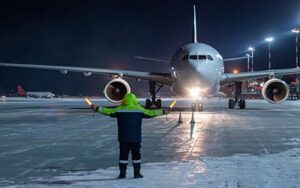
During aircraft ground operations, safety precautions must be followed carefully to prevent personnel injuries, aircraft damage, and equipment damage.
Ground handling teams must follow standard operating procedures as well as equipment safety rules.
Marshalling is one of the important parts of this safety structure.
This Marshalling Guide explains what aircraft marshalling means, why it is used, and how 34 common hand signals support safe ground movement.
Marshalling is a visual communication operation used by trained ground personnel.
It is an important part of ground handling because it helps flight crews and ground teams communicate when verbal, radio, or interphone communication is not available or not practical.
These hand gestures are especially important around aircraft parking positions, taxi guidance, pushback operations, brakes, chocks, engine start, ground power, and wingwalker communication.
In global aviation, these signs are used in both civil and military environments.
They are also supported by international standardization practices, including ICAO-related visual signal references.
You can review an ICAO document on marshalling signs here: ICAO Marshalling Signals.
This article focuses on civil aviation-related hand signals and explains them in a practical way.
The original structure is based on airport ground handling practices and IATA Airport Handling Manual references.
As always in aviation, the purpose is not to look dramatic with hand movements.
The purpose is to keep people, aircraft, equipment, and operations safe.
What Is Aircraft Marshalling?
Aircraft marshalling is the process of guiding aircraft on the ground through standardized visual signals.
The person giving these signs is usually called a marshaller.
The marshaller stands in a visible and safe position where the flight crew can clearly see the gestures.
These signs may be given with bare hands, wands, illuminated batons, or other approved signaling equipment depending on the operation and visibility conditions.
The main purpose is to help the aircraft move safely on the apron or parking area.
Marshalling may be needed when an aircraft is entering a stand, continuing taxi, turning, stopping, starting engines, setting or releasing brakes, placing chocks, or completing ground movement.
In addition to aircraft guidance, some hand signs are used between ground personnel during technical service or pushback operations.
Every sign must be clear, visible, standardized, and properly understood.
There is no room for improvisation.
Aircraft ground movement is not a place for “I think he meant this” energy.
1. Aircraft Guidance Hand Signals
1.1 Identify the Parking Stand
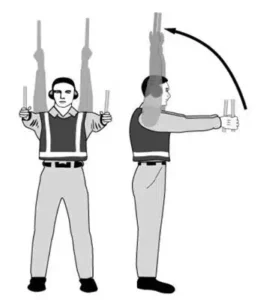
Both hands are raised above the head and moved forward and upward.
1.2 Continue Taxiing Straight Ahead
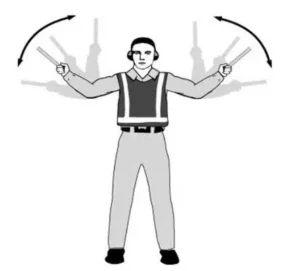
Both arms are extended sideways, bent at the elbows, and moved upward and downward.
1.3 Slow Down
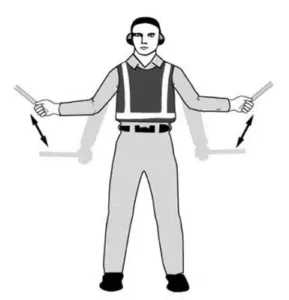
Both arms are extended sideways at waist level and moved downward.
1.4 Turn Right According to the Pilot’s View
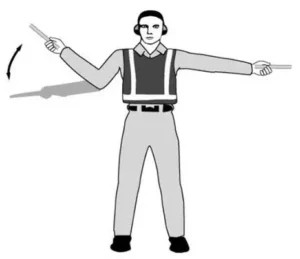
The left arm is held at a 90-degree angle from the body, while the right arm gives the continue signal.
The movement speed of the right arm shows how quickly the pilot should move.
1.5 Turn Left According to the Pilot’s View
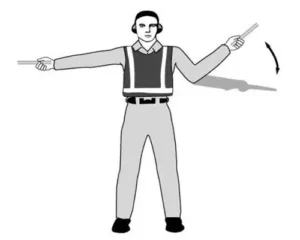
The right arm is held at a 90-degree angle from the body, while the left arm gives the continue signal.
The movement speed of the left arm shows how quickly the pilot should move.
1.6 Stop / Emergency Stop
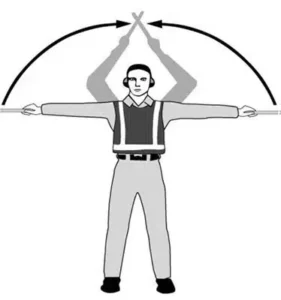
Both hands are extended sideways and then brought together above the head.
1.7 Hold Position / Wait
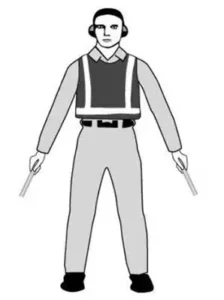
Both hands are held at the sides of the body at approximately a 45-degree angle.
The marshaller waits for the next maneuver.
1.8 Proceed to the Next Marshaller or Taxiway
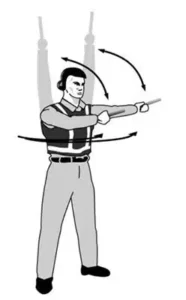
Both hands are raised vertically above the head and moved toward the next marshaller or taxiway.
This sign is used according to tower or ground control instruction.
1.9 End of Marshalling
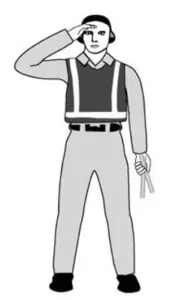
The marshaller faces the aircraft and gives a standard salute with the right hand.
Eye contact with the flight crew should continue until the aircraft begins taxiing.
1.10 Fire
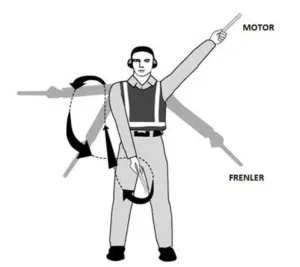
An exaggerated “8” movement is made with the right hand, while the left hand points toward the burning area.
1.11 Set Brakes
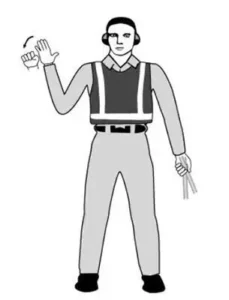
An open palm is raised upward.
Eye contact is established with the cockpit crew, and the hand is then closed.
No movement should begin until a thumbs-up confirmation is received from the flight crew.
1.12 Release Brakes
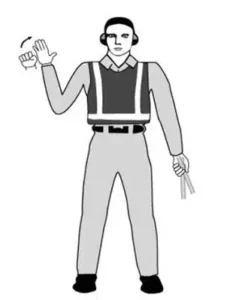
A closed fist is raised upward.
Eye contact is established with the cockpit crew, and the hand is then opened.
No movement should begin until a thumbs-up confirmation is received from the flight crew.
1.13 Insert Chocks
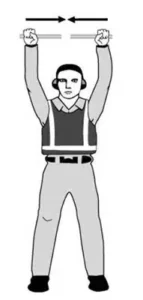
Both arms are held vertically above the head and moved inward toward each other.
1.14 Remove Chocks
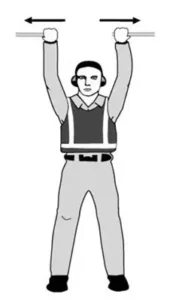
Both arms are held vertically above the head and moved outward to the sides.
1.15 Start Engine
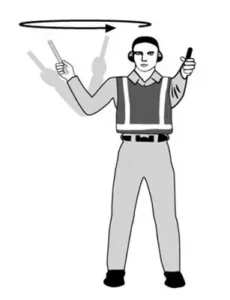
The right hand is raised to head level and moved in a circular motion.
At the same time, the left hand points toward the aircraft.
1.16 Emergency Engine Cut-Off
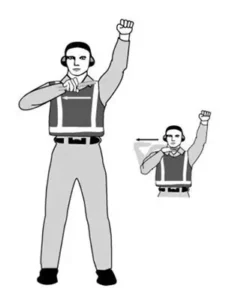
The right hand is extended toward the neck at shoulder height and pulled to the right.
The left hand is raised upward as a fist.
2. Technical Service Communication
Some hand signs are used to communicate with the flight crew during technical service or handling-related aircraft movements.
Hand signals should be used only when verbal communication is not possible.
After each sign, confirmation should be received from the flight crew.
2.1 Connect Towbar
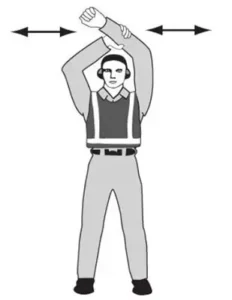
Both hands are raised above the head, and one arm is held by the other hand.
2.2 Air Up for Engine Start
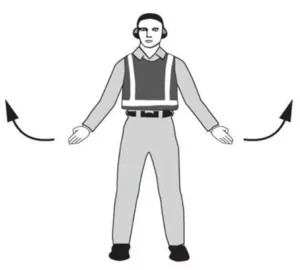
Both arms are extended sideways and moved up and down.
This sign indicates the supply of pressurized air for engine start.
3. Technical and Service Signs
3.1.a Connect Ground Power
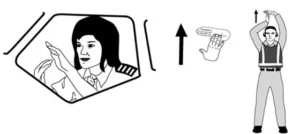
Both hands are raised above the head.
The left hand is held horizontally with the palm facing downward, while the right hand is held vertically.
The fingers of the right hand touch the palm of the left hand to form a “T” shape.
If the operation is performed at night, the same “T” shape is made with illuminated signals.
3.1.b Disconnect Ground Power
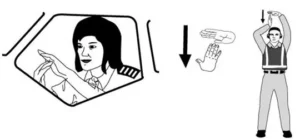
Both hands are raised above the head, forming a “T” shape with the left palm and the right fingers.
The right hand is then separated from the left hand.
Ground power must not be disconnected from the aircraft without flight crew confirmation.
If the operation is performed at night, the same “T” shape is made with illuminated signals.
3.2 Affirmative / All Clear
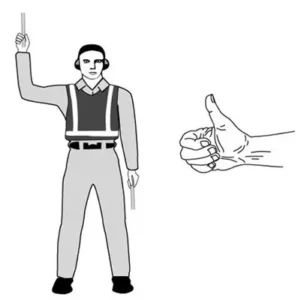
The left hand remains down at the side of the body.
The right hand is raised to head level, made into a fist, and the thumb is extended upward.
3.3 Negative
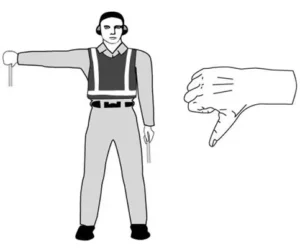
The left hand remains down at the side of the body.
The right arm is positioned at a 90-degree angle from the body.
The right hand is made into a fist, and the thumb is pointed downward.
3.4 Interphone
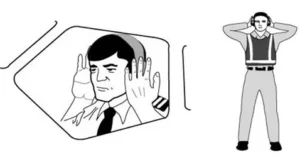
Both arms are extended sideways at a 90-degree angle from the body.
The hands are placed over the ears.
3.5 Do Not Touch Controls
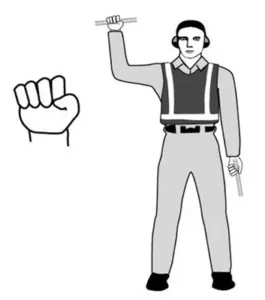
The right hand is made into a fist and held horizontally at head level.
The left hand remains down at the side of the body.
3.6 Open or Close Front / Rear Stairs
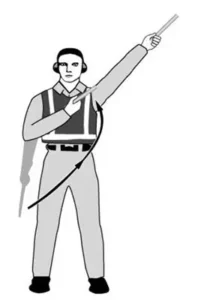
The right hand is held beside the body, while the left hand is held at head level at a 45-degree angle.
The right hand is moved toward the left shoulder.
4. Ground Personnel and Pushback Communication
The following signs are used for non-verbal communication between headset personnel and the tug operator during pushback operations.
These signs are used during towbar connection, towbar disconnection, and the beginning or end of pushback operations.
4.1 From Headset Personnel to Tug Operator
4.1.1 Release Vehicle Brakes
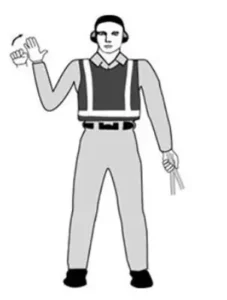
Eye contact is established with the tug operator.
The right hand is raised to shoulder level as a fist and then opened.
4.1.2 Ready to Push
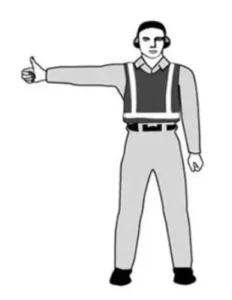
The right arm is raised at a 90-degree angle from the body.
The hand is made into a fist, and the thumb is extended upward.
This sign tells the tug operator that all equipment has been removed from the aircraft, the chocks have been removed, aircraft brakes are off, and the flight crew has approved pushback.
4.1.3 Negative / Standby
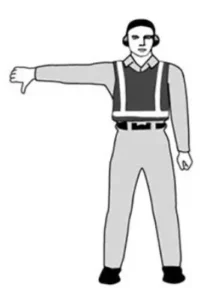
The right arm is raised at a 90-degree angle from the body.
The hand is made into a fist, and the thumb is pointed downward.
This sign tells the tug operator that the aircraft is not yet ready for pushback and that the position must be maintained.
4.1.4 Set Vehicle Brakes / Stop
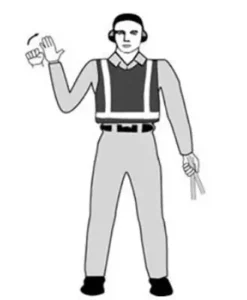
The right hand is raised open at shoulder level.
Eye contact is established with the tug operator, and the hand is then closed.
If this sign is given at the end of pushback, it indicates that the aircraft brakes have been set.
The tug operator must confirm with a sign that the vehicle brakes have been applied.
4.1.5 Slow Down
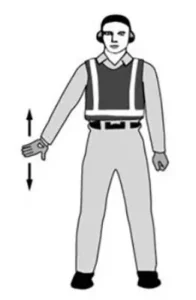
The right arm is positioned at a 45-degree angle with the lower body.
The open right hand is moved downward.
4.1.6 Change Pushback Direction
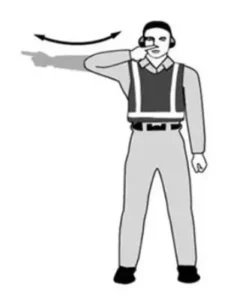
The right arm is raised at a 90-degree angle from the body.
The right index finger touches the nose and then points toward the desired turning direction of the aircraft.
4.2 From Wingwalker to Headset Personnel and Tug Operator
4.2.1 Aircraft Clear to Move
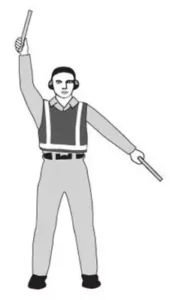
The right arm is raised upward.
The left arm is held at a 45-degree angle with the lower body.
4.2.2 Stop Aircraft Movement
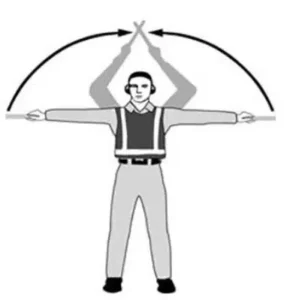
Both arms are extended sideways and then brought together above the head.
4.2.3 Hold Aircraft for Movement
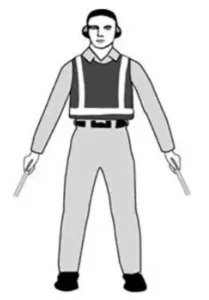
Both arms are held at the sides of the body at a 45-degree angle.
The position is maintained until the aircraft is clear for movement.
IATA AHM Safety Notes for Ground Operations
IATA AHM references are important for understanding safety considerations related to aircraft ground movement, handling procedures, and standardized communication during apron operations.
Hand signals are useful only when they are clearly visible and correctly understood.
Ground personnel must maintain safe positioning around the aircraft.
They must stay clear of engines, landing gear, moving vehicles, towbar areas, and other danger zones.
Eye contact with the flight crew, headset personnel, or tug operator is extremely important.
Confirmation should be received when the procedure requires it.
Signals must not be improvised, exaggerated beyond recognition, or mixed with unofficial gestures.
One wrong sign can create confusion.
One moment of confusion around a moving aircraft is already one moment too many.
Conclusion
This Marshalling Guide explained 34 aircraft hand signals used in ground operations, technical communication, service procedures, and pushback coordination.
These signs help ground personnel and flight crews communicate when radio, verbal, or interphone communication is not available or not enough.
They support safe parking, taxi guidance, stopping, braking, chock handling, engine start, ground power connection, pushback, and wingwalker coordination.
In civil aviation, standardization is critical.
The same gesture must mean the same thing for everyone involved in the operation.
That is why marshallers, headset personnel, tug operators, wingwalkers, and flight crews must understand the correct meaning of these signs.
Safe ground movement depends on training, attention, coordination, and procedure discipline.
In aviation, even a simple hand gesture can be a safety barrier.
And honestly, when there is a moving aircraft nearby, “simple” does not mean “unimportant.”
Sources:
1. AHM Safety Considerations for Aircraft Movement Operations
Best regards.