

Algorithm Examples: 5 Practical Types
Before answering the question “What is an algorithm?”, it is useful to understand why this concept is necessary.
Today, with the rapid development of technology, businesses, public institutions, software teams, and digital platforms increasingly use tools such as artificial intelligence, data analysis, automation, and decision-support systems.
For these tools to work successfully, one of the most basic concepts must be understood clearly: the algorithm.
An algorithm is not only a computer science term.
It is also a way of thinking.
When we solve a problem step by step, organize a process, make a decision according to conditions, or repeat a task in a controlled way, we are already using algorithmic logic.
In programming, this logic becomes much more formal.
Computers cannot understand vague instructions such as “do something reasonable.”
They need clear, ordered, and predictable instructions.
That is where algorithms become essential.
In this article, we will explain what an algorithm is, why it is important, which features it has, and 5 practical Algorithm Examples used in different areas.
What Is an Algorithm?
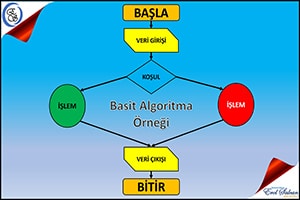
An algorithm is a specific method or path used to solve a problem.
In simple terms, it is a set of step-by-step instructions.
It explains the actions required to complete a task and shows the correct order of these actions.
For example, making tea, calculating a total price, sorting names alphabetically, finding the shortest route, or filtering spam emails can all be described with ordered steps.
The important point is that the steps must be clear and executable.
An instruction such as “make it better” is not enough for a computer.
The system needs to know what “better” means, which data to use, which condition to check, and what result to produce.
That is why algorithms are so important in software development.
They turn a problem into a structured process.
Although problem solving in daily life and designing a process for a computer program may look similar at first, they are not exactly the same.
In daily life, people can use intuition, experience, emotion, and common sense.
Computers do not have that luxury.
A program must follow precisely defined instructions.
So yes, computers are powerful, but they are also extremely literal.
If you tell them nonsense confidently, they will execute the nonsense confidently. Very professional, very terrifying.
Main Features of an Algorithm
Algorithms have several important features.
These features help make a process clear, reliable, reusable, and suitable for solving problems.
Without these features, a set of instructions may become confusing or impossible to implement.
-
Step-by-Step Instructions
An algorithm includes instructions that are followed in a specific order.
These instructions show the correct path required to solve a problem.
Each step should be understandable and connected to the next step.
If the order is wrong, the result may also be wrong.
For example, in a login system, checking the password before receiving the username would not make much sense.
The process must follow a logical order.
-
Precision
Each step must be clearly defined.
Precision means there should be no unnecessary uncertainty in the instructions.
If a step can be interpreted in many different ways, the process becomes unreliable.
In computer systems, this is especially important because software cannot guess the developer’s intention.
Clear instructions make the result more predictable.
-
Input and Output
An algorithm usually receives input and produces output.
Input is the data required for the process to work.
Output is the result produced after the steps are completed.
For example, in a simple calculator operation, the input may be two numbers and an operator.
The output is the calculated result.
This structure is one of the foundations of programming logic.
-
Finite Steps
An algorithm should not continue forever without reaching a result.
It must have a limited number of steps or a clear stopping condition.
If there is no stopping condition, the process may turn into an infinite loop.
And an infinite loop is basically a computer’s way of saying, “I live here now.”
Finite steps make the process controllable and useful.
-
General or Specific Use
An algorithm can be designed for a specific problem or for general use.
For example, a process that calculates the salary of one company’s employees may be specific.
A sorting process that can organize any list of numbers may be general.
Good design often makes instructions reusable in different situations.
Why Are Algorithms Important?
The importance of algorithms can be seen in many fields.
As technology develops, their role becomes even more visible.
They help systems work correctly, efficiently, and automatically.
They are used in software development, data analysis, artificial intelligence, engineering, business operations, finance, logistics, education, healthcare, and many other areas.
-
Accuracy
A well-designed process helps produce correct results.
Because the instructions are defined step by step, the system follows the same logic each time.
This reduces the risk of random or inconsistent outcomes.
Of course, accuracy also depends on correct input and proper design.
If the steps are wrong, the result will be wrong too.
-
Efficiency
Efficiency means solving a problem with less time, less effort, or fewer resources.
A good process removes unnecessary steps and focuses on the most suitable path to the result.
This is important in both small and large systems.
For example, searching through ten items is easy.
Searching through ten million records requires much better planning.
-
Controlled Output
Algorithms can stop an operation, continue it, repeat it, or move to another operation depending on conditions.
This gives control over the process.
For example, if a user enters the wrong password, the system can show an error message instead of allowing access.
The output also informs the user about the result of the operation.
-
Reusability
A well-designed solution can be reused when the same or similar problem appears again.
This saves time and improves consistency.
In software development, reusable logic is extremely valuable.
Developers do not want to rebuild the same wheel every day.
Especially not if that wheel already has bugs from last week.
-
Ease of Development and Maintenance
Step-by-step logic makes development and maintenance easier.
If a change is needed, developers can focus on the related step instead of rewriting the entire system.
This is important for long-term projects.
Clear logic also helps teams understand the system faster.
-
Automation
Automation allows repeated tasks to be performed with less human effort.
Algorithms make automation possible by defining what should happen and when it should happen.
This can reduce human error, speed up operations, and improve reliability.
Automation is used in factories, banking systems, customer service tools, recommendation engines, and many digital platforms.
5 Algorithm Examples
Algorithms are used in many different areas.
They can be simple enough for a beginner programming exercise or complex enough to power artificial intelligence systems.
Below are 5 Algorithm Examples that show how this concept appears in practical fields.
-
1. Search Algorithms
A search algorithm is used to find a specific item inside a collection of data.
For example, you may search for a person’s name in a phone directory or a product in an online store.
The simplest search method checks items one by one until the target is found.
This works, but it can be slow when the data is large.
More advanced methods can search faster if the data is organized properly.
Search systems are used in websites, databases, file systems, contact lists, search engines, and software applications.
When you type a word into a search box and get results quickly, there is structured logic working behind the scenes.
-
2. Sorting Algorithms
A sorting algorithm is used to arrange items in a specific order.
For example, a list of people can be sorted alphabetically by name or numerically by age.
Products can be sorted by price, date, rating, or popularity.
Sorting is one of the most common operations in computer science.
Different sorting methods have different performance levels.
The best choice depends on the size of the data, the structure of the data, and the system requirements.
For small lists, a simple method may be enough.
For large datasets, a more efficient approach is usually required.
-
3. Mathematical Algorithms
Mathematical algorithms are used to solve numerical and logical problems.
They can be used for operations such as calculating averages, solving equations, finding prime numbers, performing numerical integration, or processing statistical data.
They are widely used in engineering, finance, physics, data science, computer graphics, and simulation systems.
For example, a financial application may use mathematical logic to calculate loan payments.
An engineering program may use it to analyze structural loads.
A scientific tool may use it to process experimental results.
This type of structured calculation is one of the reasons computers are so useful in technical fields.
-
4. Data Mining Algorithms
Data mining algorithms are used to extract useful information from large datasets.
They help identify trends, patterns, relationships, and hidden structures in data.
For example, a company may analyze sales data to understand customer preferences.
An e-commerce platform may use data analysis to recommend products.
A bank may examine transaction data to detect suspicious activity.
These methods are important because large datasets are difficult to examine manually.
Data mining helps turn raw data into meaningful information.
This information can support business decisions, marketing strategies, risk analysis, and operational planning.
-
5. Artificial Intelligence Algorithms
Artificial intelligence algorithms are used in systems that can recognize patterns, make predictions, understand language, classify images, or support decision-making.
They are often used together with machine learning and deep learning techniques.
For example, image recognition systems can identify objects in photos.
Natural language processing systems can analyze text or understand speech.
Recommendation systems can suggest movies, products, music, or content based on user behavior.
These systems are now part of daily life.
They appear in mobile apps, search engines, social media platforms, translation tools, voice assistants, and smart devices.
Of course, artificial intelligence does not remove the need for human judgment.
It only makes the quality of the underlying logic more important.
How Algorithms Are Used in Programming Logic
Programming logic depends heavily on algorithmic thinking.
Before writing code, a developer usually needs to understand the problem clearly.
Then the developer decides which steps are required to solve it.
This may include receiving input, checking conditions, repeating operations, processing data, and producing output.
For example, a basic login system can be described with simple steps.
First, the system receives the username and password.
Then it checks whether the user exists.
After that, it compares the password with stored data.
If the information is correct, access is granted.
If it is incorrect, an error message is shown.
This is a simple example, but the same logic appears in larger systems too.
Online shopping carts, banking applications, airport systems, reservation platforms, and automation tools all depend on structured decision processes.
Common Mistakes When Designing Algorithms
One common mistake is starting with code before understanding the problem.
This usually creates confusion and unnecessary work.
A better approach is to define the problem first.
Then the required inputs, expected outputs, conditions, and steps should be planned.
Another mistake is ignoring edge cases.
An edge case is a situation that does not happen often but can break the system if it is not handled.
For example, what happens if the user enters an empty value?
What happens if a list has no items?
What happens if the file does not exist?
Good design considers these possibilities.
A third mistake is making the process more complex than necessary.
Complexity is not always a sign of intelligence.
Sometimes it is just confusion wearing a suit.
A simple, readable, and efficient solution is often better than a complicated one.
Conclusion
Algorithm Examples help us understand how structured problem solving works in technology and daily life.
An algorithm is a step-by-step method used to solve a problem or complete a task.
It receives input, follows defined instructions, and produces output.
Its main features include precision, ordered steps, finite methods, input-output structure, and reusable logic.
Algorithms are important because they support accuracy, efficiency, controlled output, reusability, easier maintenance, and automation.
They are used in search systems, sorting processes, mathematical calculations, data mining, artificial intelligence, software development, engineering, business, and many other fields.
As technology continues to develop, understanding this concept becomes even more important.
Whether you are learning programming, working with data, using automation tools, or trying to understand artificial intelligence, algorithmic thinking is one of the strongest foundations.
Best regards.