

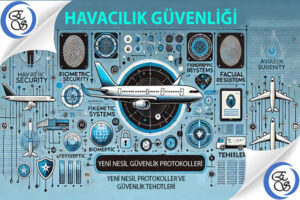
 Aviation security is undergoing a major transformation worldwide due to rapidly evolving threats and new security measures. From cybersecurity risks to automation and biometric identification, many innovations are being implemented to ensure passenger safety. In this article, we will examine the modern security protocols developed to improve the safety of aircraft and passengers, as well as the threats the aviation industry faces today.
Next-Generation Threats in Aviation Security: What Has Changed?
Air travel is still considered one of the safest modes of transportation today. However, with the advancement of technology, the nature of threats has also changed. Today, security is no longer limited to physical protection; digital security has become equally important. In the past, the aviation industry mainly focused on preventing physical threats such as terrorism and armed attacks. Today, however, cyberattacks and data security risks are also part of the threat landscape.
Among modern threats, cyberattacks targeting aircraft digital systems, fake identities, and vulnerable air traffic control systems stand out. Today, attacks against airline reservation and check-in systems especially threaten users’ personal data. For this reason, cybersecurity has become an indispensable part of the aviation industry.
Cybersecurity and Aviation: How Are Digital Systems Protected?
With the digitalization of the aviation industry, cybersecurity risks are emerging in many areas, from airports to aircraft cockpits. These risks may affect not only the protection of data but also flight safety directly. Airlines, air traffic control centers, and airports process billions of data packets every day, and this data can become a target for cyber attackers.
To strengthen cybersecurity measures, the aviation industry uses methods such as data encryption, strong firewalls, multi-factor authentication, and regular security audits. In addition, AI-powered analytics tools are being deployed to continuously monitor all digital systems and detect threats early. In this way, in the event of a possible security breach, rapid intervention can be provided and system security can be protected.
Automation in Air Traffic Control: Advantages and Risks
Air traffic control (ATC) systems are increasingly moving toward automation. These systems are used to determine flight routes more accurately, use airspace more efficiently, and improve flight safety. However, the spread of automation also brings new threats.
While automated systems reduce human error, they may also become vulnerable to cyberattacks. Automation systems used in high-capacity airspace management offer major advantages for air traffic control, but in the event of a security vulnerability, they may pose risks with serious consequences. For this reason, regular updates and software checks are extremely important to ensure that automation systems operate safely.
Biometric Security Technologies: Facial Recognition and Fingerprint Recognition Systems
Biometric security technologies are becoming increasingly widespread at airports in order to speed up security processes and improve overall safety. Biometric systems such as facial recognition, fingerprint recognition, and iris scanning offer important solutions for reducing threats such as fake identities and identity theft. These systems verify passengers’ identities while making security checkpoints faster and safer.
However, the use of biometric security systems also brings certain privacy concerns. The protection of personal data is one of the biggest challenges of biometric security systems. Secure storage of passengers’ personal data, ensuring that the data is accessible only by authorized individuals, and protecting the security of data analysis performed by biometric systems are vital for the success of these technologies.
AI-Powered Security Solutions: Detecting Threats in Advance
Artificial intelligence is becoming increasingly important in aviation security. AI can analyze images from security cameras to detect suspicious situations, monitor passenger behavior to identify possible threats in advance, and send alerts to security personnel to help prevent potential risks. In addition, AI-powered systems are also used in air traffic control to provide safer and more efficient airspace management.
Artificial intelligence offers great potential in analyzing and identifying potential threats in advance. Although this provides a major advantage for flight safety, AI systems must be properly programmed and updated regularly. In addition, transparency regarding how AI analyzes data and what conclusions it reaches will make it possible to use this technology more reliably.
The Use of Blockchain in Aviation Security: Secure Data Storage
Blockchain technology, which has become popular in recent years, also stands out as a promising solution in aviation security for storing and processing data securely. Since blockchain allows data to be stored in a distributed structure, it offers a more resilient framework against cyberattacks.
Blockchain-based security solutions can create a secure infrastructure for digital systems and passenger data used in the aviation industry. Through this technology, passengers’ personal data can be stored more securely, and greater transparency can be achieved in airport security procedures.
The Future of Aviation Security: What Innovations Are Expected?
The role of technology in aviation security is rapidly increasing, and this field is being supported by new solutions every day. In the future, a safer flight experience is expected through unmanned aerial vehicles, security personnel equipped with augmented reality glasses, AI-powered smart control systems, and advanced biometric solutions.
Next-generation security solutions improve safety both onboard aircraft and throughout airport processes, while also positively affecting the passenger experience. These technologies, which offer speed and accuracy in airport security, will continue to play an important role in the aviation industry in the coming years.