Aviation Quality Policy: 9 Key Elements
You can listen to the article instead of reading it. To do so, simply click the player below.
Aviation Quality Policy

Aviation is guided by many national and international regulations and standards to ensure that people travel safely and under high standards.
As you may remember, I previously discussed the regulatory framework here >>>.
A quality policy is a plan or strategy that defines an organization’s quality objectives and how it will achieve them.
Although authorities define the general framework, each organization determines how these rules will be applied in practice.
In aviation, this policy is necessary not only for passenger safety but also for reducing costs and improving customer satisfaction.
In aviation, a quality policy is used by many different organizations such as airlines, airports, maintenance and repair organizations, air traffic control centers, and other aviation companies. Moreover, it is a requirement.
This policy helps each organization define its quality objectives and the methods it will follow to reach them.
It should also include goals such as improving customer satisfaction, reducing costs, and increasing efficiency in business processes.
Aviation Quality Policy and Aviation Standards

An Aviation Quality Policy is created to define the quality objectives of organizations in the aviation sector.
Aviation standards provide the common framework that helps aviation organizations maintain safe, consistent, and measurable operations.
Without these standards, each organization would interpret quality in a different way.
This would create serious problems in safety, documentation, audits, training, and operational control.
For this reason, quality policy should not be seen as a simple written statement.
It should be connected to daily operations, regulatory requirements, internal audits, and employee responsibilities.
It also identifies the methods required to achieve these objectives and provides the necessary resources for successful implementation.
How the rules set by authorities will be applied is also part of this policy.
It should include goals such as customer satisfaction, cost reduction, and better process efficiency.
In the aviation sector, this policy is generally created in line with at least ISO 9001 Quality Management System standards.
In addition, the rules of the regulatory authority, such as SHGM, must be considered and followed as a priority.
These standards define the requirements for an organization’s quality management system.
They also provide a framework for reaching quality objectives.
As a result, aviation businesses can improve efficiency while keeping customer satisfaction and safety at a high level.
Why Is Quality Policy Important in Aviation?

In aviation, quality policy defines the requirements needed to prioritize safety, increase customer satisfaction, reduce costs, and improve business processes.
Here, the meaning of “customer” may change depending on the organization.
For an airline, customers may be passengers.
For an aircraft maintenance organization, customers may be the operators whose aircraft are maintained.
For a ground handling company, customers may be airlines.
This policy also plays a critical role in aviation safety.
Organizations applying quality policy accept that they must take all necessary measures to protect passengers and personnel.
They must also comply with all international regulations related to air transport safety.
Quality policy can increase competition among airlines and airports by improving customer satisfaction.
Competition in aviation is directly linked to service quality and trust.
Before flights, customers may review airline records related to safety, service quality, and customer service.
Based on these records, they decide which airline they prefer.
Therefore, airlines must offer high service quality and strong customer support to satisfy passengers.
Quality policy can also reduce operating costs in the aviation sector.
A well-designed quality management system can reduce costs and improve profitability.
This is especially important for maintenance and repair organizations.
High-quality maintenance services help aircraft fly safely.
This also helps airlines reduce costs in the long run.
Quality policy can also improve efficiency in business processes.
A good system makes processes more effective and consistent.
This allows organizations to save both time and money.
It can also improve cooperation and coordination among employees in the air transport industry.
Quality Culture in Aviation Organizations
Quality culture is one of the most important foundations of aviation operations.
A written policy alone cannot create real quality.
Employees must understand why procedures exist and how their actions affect safety, efficiency, and customer satisfaction.
In aviation, even small mistakes can create major consequences.
For this reason, quality culture should be supported by training, communication, reporting systems, and management commitment.
Managers should not treat quality only as an audit requirement.
They should show that quality is part of daily decision-making.
When employees see that quality rules are taken seriously by leadership, they are more likely to follow and support these rules.
This approach also improves trust inside the organization.
Personnel become more willing to report problems, suggest improvements, and participate in corrective actions.
In short, a strong quality culture turns written rules into daily behavior.
That is the part where many organizations either win or quietly sabotage themselves with beautiful documents nobody actually follows.
Aviation Quality Policy Elements
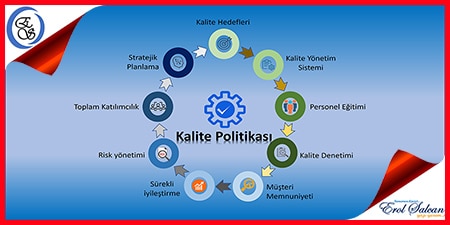
The elements of a quality policy in aviation may vary according to each organization’s objectives.
However, they usually include the following core areas.
-
1. Quality Objectives
The starting point of a quality policy is defining the organization’s quality objectives.
These objectives may cover customer satisfaction, safety, efficiency, profitability, and business processes.
Clear objectives also make performance easier to measure.
Without measurable targets, quality becomes a nice sentence on paper rather than a real management tool.
-
2. Quality Management System
The quality management system ensures that the organization applies its quality policy properly.
This system consists of documented procedures, instructions, and guidelines.
A strong system standardizes business processes, increases efficiency, and helps reduce errors.
Only in this way can a common standard be created in quality policy processes.
Perhaps this is why people say that “an aircraft flies with at least its own weight in documents.” Just imagine all the documents used from the design of an aircraft to the execution of its operation.
-
3. Personnel Training
Quality policy in aviation provides continuous training and development to improve personnel competence.
Personnel must understand the quality management system and quality objectives.
This helps the organization reach its targets.
Regulatory authorities already define mandatory training policies in this area.
Initial and recurrent training must be provided to personnel as a requirement.
However, organizations may also need additional training programs based on their own objectives.
Training should not be limited to simply completing a form or signing an attendance sheet.
Personnel should understand how the training content connects to real operational risks.
-
4. Quality Audits
Quality audits check whether the organization complies with its quality management system and quality objectives.
These audits are used to measure the effectiveness of the system.
Quality units should conduct planned and unplanned audits within the organization.
This keeps the organization alert in terms of compliance with rules and quality policy.
However, regulatory authorities may also audit both operational units and quality departments.
If weaknesses are detected, serious sanctions may appear.
Documentation and Audit Readiness
Documentation is one of the strongest pillars of quality management in aviation.
Every procedure, responsibility, corrective action, and training record should be traceable.
This traceability helps organizations prove that they follow both internal rules and external requirements.
Audit readiness does not mean preparing documents only before an inspection.
It means keeping the system organized and updated at all times.
When documentation is weak, even a well-functioning process may appear unreliable during an audit.
For this reason, aviation organizations should regularly review their records, procedures, and evidence of compliance.
A document that is outdated, unclear, or impossible to apply can create more problems than no document at all.
That is why document control should be treated as a serious part of the quality system.
-
5. Customer Satisfaction
Quality policy aims to improve customer satisfaction.
This is achieved by evaluating customer feedback and responding to customer needs.
As mentioned above, the customer may differ depending on the type of aviation organization.
For an airline, it may be passengers.
For a maintenance organization, it may be aircraft operators.
For a handling company, it may be airlines.
Customer feedback should not be collected only for appearance.
It should be analyzed, categorized, and turned into corrective or preventive actions when necessary.
-
6. Continuous Improvement
Continuous improvement is one of the key goals of quality policy in aviation.
Aviation is a constantly developing sector.
For this reason, rules and policies are living structures that require regular development.
This is achieved by reviewing and improving the quality management system.
It also requires reducing errors and making processes more efficient.
Continuous improvement also helps organizations adapt to technological and operational changes.
New aircraft systems, digital tools, security expectations, and passenger needs can all affect quality processes.
An organization that never updates its procedures slowly becomes outdated.
-
7. Risk Management
Risk management in aviation is extremely important for maintaining flight safety.
Airlines and other aviation organizations must identify possible risks.
They must analyze these risks and create preventive strategies.
Risk management can also be used to detect problems that may affect flight safety and customer satisfaction before they occur.
This approach allows organizations to act before a small weakness turns into a serious operational event.
-
8. Total Participation
Total participation means that all employees in an organization actively participate in the quality management process.
This emphasizes that quality is not only the responsibility of managers or a single department.
All employees also have responsibilities in this process.
As a result, better cooperation, creativity, and workplace safety can be expected.
When employees are excluded from quality processes, the system becomes weak.
The people who perform daily operations often see problems before managers do.
For this reason, their feedback should be taken seriously.
-
9. Strategic Planning
Strategic planning means integrating the quality management process with the organization’s strategic objectives.
It also means including quality management in all business processes.
This allows an organization to use quality management not only to improve quality but also to reach long-term strategic goals.
In short, all these concepts explain the foundations of quality policy in an aviation organization.
Quality Policy, Compliance, and Long-Term Success
A strong quality policy also helps organizations prepare for future operational challenges.
As aviation becomes more digital, complex, and competitive, quality systems must also improve.
Organizations that regularly review their processes can detect weaknesses earlier.
This gives them the chance to take corrective and preventive actions before problems grow.
In this sense, quality policy is not only about compliance.
It is also about resilience, trust, and long-term organizational success.
Aviation organizations that treat quality as a living system can respond to change more effectively.
They can also create a safer and more reliable service environment for customers, personnel, and business partners.
On the other hand, organizations that see quality only as paperwork usually discover the real cost of this mistake during audits or incidents.
And by then, naturally, everyone suddenly remembers how important quality was supposed to be.
That is all for now.
Respectfully,