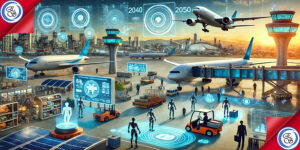
 Aviation’s 2040 and 2050 Vision While thinking about aviation’s 2040 and 2050 vision, I came across this >> news article on Airline Haber, a portal managed by Mr. Tolga İNAN and inherited from the late Sefa Abi to his son, and in a way, to all of us.
You can read the news from the link, but for those who have not read it, let me briefly summarize:
It was titled “Airbus’s Single-Pilot Flight Plan Sparks Debate” and discussed reactions from the industry, especially from cockpit crews.
As someone who had previously written, albeit briefly, about this subject in this >>> article and under various other headings, I wanted to write my predictions again, this time in greater depth.
Note: As a society, we do not really have the habit of reading long content, but I will still write this as a rather long note for history. Let us see how many of my predictions will come true when that day arrives. 😊
Here we go:
The progress made over the last 20 years has had a greater impact and acceleration than the previous thousands of years in human history. Shall we look at a few points to make this claim more concrete?
- Speed and Access: Technological advances have become instantly accessible worldwide thanks to digitalization. For example, the spread of the internet allows people to access information within seconds.
- Inclusiveness: In the past, an innovation was usually used only by a small elite group. Today, technologies such as smartphones and artificial intelligence affect the lives of billions of people.
- The Multiplier Effect of Innovations: Interconnected developments such as artificial intelligence, the Internet of Things (IoT
 IoT (Nesnelerin İnterneti), fiziksel cihazların, sensörlerin ve yazılımların internet aracılığıyla birbirleriyle ve merkezi sistemlerle veri alışverişi yaparak etkileşimde bulunmalarını sağlayan bir teknolojidir. IoT sayesinde cihazlar veri toplayabilir, analiz edebilir ve uzaktan kontrol edilebilir hâle gelir. Havacılık sektöründe IoT; uçak bakım süreçlerinin optimize edilmesi, gerçek zamanlı veri paylaşımı, yolcu deneyiminin iyileştirilmesi ve operasyonel verimliliğin artırılması gibi alanlarda büyük rol oynar. Özellikle 2040 ve 2050 vizyonlarında IoT, havacılık operasyonlarının daha akıllı, güvenli ve sürdürülebilir hâle gelmesinde kritik bir teknoloji olarak öne çıkacaktır.), and genetic engineering create chain reactions in fields that can each cause major transformation on their own.
 - Leapfrog Developments: In the past, innovation usually accumulated slowly over time. Today, revolutionary changes can happen within only a few years (for example, the spread of electric vehicles or the impact of artificial intelligence in healthcare).
Now, while such development is taking place, how reasonable is it to say, “we do not want it”?
Let us even think of our grandparents. When they were born or when they were young, not only technology but even electricity was a luxury. And look at what they are exposed to today…
Anyway, without stretching the introduction too much, let us dive into the aviation industry and my predictions about it. 😊
Of course, what I will write from this point on consists of my personal opinions and only binds me. (Of course, we can discuss them)
Units and Professions Involved in a Flight Operation in Aviation
There are many units and professions directly and indirectly involved in a flight operation. Here are the main ones:
- Operations Control Center (OCC): Flight planning, route determination and emergency management.
- Pilots (Cockpit Crew): Safely flying the aircraft.
- Cabin Crew: Passenger safety and comfort.
- Technical Maintenance and Repair Team: Ensuring the technical safety of the aircraft.
- Air Traffic Control (ATC): Regulating aircraft takeoffs, landings and movements within airspace.
- Ground Services (Ramp Operations, Passenger Services): Baggage loading, refueling, aircraft parking and towing services, check-in, boarding and customer support services.
- Cargo Operations, Customs and Security Units: Cargo loading and transportation.
Before discussing these one by one, I think it is useful to state the following.
In aviation’s 2040 and 2050 vision, in my opinion, the aircraft will become part of the network as a smart object, just like in the Internet of Things. In other words, each system will be managed by a computer. In this context, I see Airbus as more fortunate in terms of adaptation.
If we elaborate a little further from the perspective of Airbus and Boeing:
I believe both of these major players have equally major responsibilities, especially in integrating technological innovations into aircraft design and meeting sustainability goals.
If We Look Generally at the Roles of Airbus and Boeing:
-
Sustainability Technologies:
- Designing electric and hybrid aircraft.
- Developing new materials and fuel technologies to reduce carbon emissions to zero.
- Developing more efficient aerodynamic designs.
-
Autonomous Flight Systems:
- Integrating more advanced versions of “Fly-by-Wire” technology.
- Designing the artificial intelligence and sensor systems required for fully autonomous aircraft.
- Integrating more advanced versions of “Fly-by-Wire
-
IoT and Digitalization:
- Building the infrastructure required for aircraft to become fully compatible with the Internet of Things (IoT) ecosystem.
- Developing systems that provide real-time communication with ground operations, flight control centers and other aircraft.
-
Next-Generation Materials:
- Increasing the use of composite materials to make aircraft lighter and more durable.
- Reducing maintenance and operating costs.
Considering All This, Airbus’s Advantages in My Opinion
Airbus appears to be one step ahead of Boeing in sustainability and innovative design:
- Electric and Hybrid Aircraft: With its “ZEROe” project, Airbus is leading the process of developing hydrogen-powered zero-emission aircraft.
- Digitalization: With digital platforms such as “Skywise,” Airbus stands out in data-driven operations by offering aircraft performance monitoring and analytics services to airlines.
- Sustainability Initiatives: As a European-based company, Airbus follows a strategy that is more aligned with the sustainability policies of the “EU.”
Again, in My Opinion, Areas Where Boeing Has Advantages:
Boeing has a strong history, especially in wide-body aircraft production and operational durability:
- Long-Range and High-Capacity Aircraft: Boeing is a leader in long-haul flights with fuel-efficient models such as the 787 Dreamliner.
- Military Aviation and Technology Transfer: As is well known, Boeing is also a leading company in developing military aviation technologies. This position gives it an advantage in offering innovative solutions in civil aviation.
- Crisis Management: Boeing has very serious experience in solving problems and restructuring during crisis periods (for example, the 737 MAX).
Airbus vs Boeing: Who Is More Advantageous?
- Technological Transformation: Airbus displays a more aggressive approach in autonomous flight and zero-emission technologies.
- Market Diversity: Boeing is strong in wide-body aircraft, but it does not move as quickly as Airbus in digitalization and sustainability.
- Regional Policies: Airbus is more integrated with Europe’s environmentally focused policies, while Boeing follows a different path with US-centered strategies.
As a result, in my opinion, Airbus is one step ahead in this technology war.
What do you think?
Now let us move step by step into the 2040 and 2050 vision of civil aviation:
2040 and 2050 Vision: The Impact of Artificial Intelligence and Robots
-
Operations Control Center (OCC)
AI can optimize flight planning and analyze variables such as weather and traffic in real time. In addition, real-time data coming from aircraft included in the “IoT” ecosystem can be analyzed and consolidated on the IOCC side, after which the relevant units can be activated. After that, fully autonomous systems will come into play, and human intervention will only be required in extraordinary situations.
In this scenario, I expect a reduction of up to 80% in demand for human labor.
-
Pilots (Cockpit Crew):
Now we have come to the news content and profession that caused me to write this article. Let me say at the beginning what I would otherwise say at the end: no matter how much resistance there is, this transformation will be inevitable. One way or another, the transformations I will mention below will happen. In fact, the biggest obstacle to this today is public opinion. Because the ground for this was already prepared years ago with “LVO CAT IIIc.”
Has “GNSS” not already started slowly replacing “GPSGPS (Global Positioning System), ABD tarafından geliştirilen uydu tabanlı bir küresel konumlandırma sistemidir. Kullanıcıların dünya üzerindeki konumlarını, hızlarını ve zaman bilgilerini yüksek doğrulukla belirlemelerini sağlar. GPS, 31 aktif uydu kullanarak hava, kara ve deniz navigasyonu gibi çeşitli alanlarda kritik bir rol oynar.”?
As a result, autonomous flight systems will become widespread, and pilots will move into a supervisory role. Single-pilot systems and fully autonomous flights on short routes will become the norm. What comes next is obvious: completely pilotless flights…
According to this scenario, human labor roles will be reduced mostly to a supervisory level, and this supervision may become a function of the OCC. As a result, there may be a 50% reduction in the need for human labor.
-
Cabin Crew:
At present, cabin crew members assigned to each flight have certain duties, and the number of crew members flying depends on international and national rules, as well as company rules prepared in accordance with them. I do not want to go into details here and extend the article further. We will proceed based on the minimum.
In the 2040 and 2050 vision, I foresee robots taking over catering services. In addition, they may partially take part in emergency procedures as well. However, AI may remain helpless for now in situations requiring emergency medical intervention and/or emotional intelligence.
For this reason, I foresee a 50% loss of human labor.
-
Technical Maintenance and Repair Team:
As is known, technical maintenance in “MROGNSS (Global Navigation Satellite System), dünya çapında konumlandırma, navigasyon ve zamanlama hizmetleri sağlayan uydu sistemlerinin genel adıdır. GPS (ABD), GLONASS (Rusya), Galileo (Avrupa) ve BeiDou (Çin) gibi bölgesel veya küresel sistemleri kapsar. GNSS, birden fazla sistemin kombinasyonu sayesinde yüksek doğruluk, kesintisiz kapsama alanı ve güvenilirlik sunarak havacılık, denizcilik ve kara ulaşımında kritik bir rol oynar.” organizations is divided into two: “line maintenance” and “base maintenance.”
If we first consider the line maintenance side of the subject, we can say that this function itself is also divided into troubleshooting and routine line tasks. The troubleshooting side of the job may almost disappear. Because, as I mentioned earlier, our aircraft included in the IoT ecosystem will transmit its failures and possible failures to the OCC. In next-generation aircraft, failures will generally be system-related, and such system interventions may be carried out by robots and/or by the aircraft itself. (simple resets, circuit breaker issues, etc.)
Periodic maintenance, replenishments and base maintenance services outside this scope will also develop significantly, but they will still require human intervention.
Accordingly, I foresee human labor in technical services decreasing by around 50%.
Of course, I did not go into more specific technical details such as production planning, etc. Maybe I will address these topics in the future. Who knows?
-
Air Traffic Control (ATC):
I foresee AI-supported air traffic control systems becoming widespread and autonomous systems managing air traffic, with human control remaining limited. Accordingly, I expect a reduction of up to 80% in human labor.
-
Ground Services (Ramp Operations, Passenger Services):
I foresee ramp services and ground operations shifting completely to automation and minimizing dependence on humans. Tasks such as aircraft loading and unloading, refueling, towing operations, check-inFly-by-Wire (FBW), uçakların kontrol sistemlerini elektronik sinyallerle yöneten bir teknolojidir. Pilotun komutları, doğrudan mekanik bağlantılar yerine elektronik sinyaller aracılığıyla uçuş kontrol bilgisayarına iletilir. Bilgisayar bu komutları işleyerek, uçağın kanatçık, dümen gibi kontrol yüzeylerini hareket ettirir. Bu sistem, uçuş güvenliğini artırır, ağırlığı azaltır ve hassas manevra kabiliyeti sağlar., boarding ZEROe, Airbus tarafından geliştirilen, sıfır emisyonlu uçakların geleceğini temsil eden bir konsepttir. Bu projede, hidrojen yakıt hücreleri ve yenilikçi tasarımlar kullanılarak tamamen çevre dostu uçuşlar hedefleniyor. ZEROe kapsamında üç farklı uçak tasarımı sunulmuştur: turbojet, turboprop ve kanat gövde birleşimli modeller. Bu konsept, 2035 yılına kadar hidrojenle çalışan ticari uçakların hizmete girmesini amaçlamaktadır ve havacılık sektörünün sürdürülebilirliğine öncülük etmeyi hedefler., customer support services and baggage handling may largely be performed by robots and autonomous vehicles. Accordingly, almost all airport processes may become fully automated, and many tasks may be taken over by the OCC and/or airport operators’ operation control centers. In this context, I believe the need for human labor in this field may decrease by 90%.
-
Cargo Operations, Customs and Security Units
As I mentioned above, since all airport service units will move entirely to AI-controlled systems, cargo operations will also be affected by this transformation. The loadmaster function will be performed entirely by AI. The design of suitable loading equipment will, of course, also be part of this transformation.
In customs protection and security units, although human intervention may not disappear completely, AI will take over routine checks and document control tasks.
In this context, I foresee human dependency in the professions within this category decreasing by around 80%.
Now I have addressed this many sectors and written my predictions. Whether they happen or not, whether they are right or wrong, as I said, they bind only me. Of course, you can also write your predictions, and I would gladly publish them.
- Now, the managers who read this article (if anyone reads it, of course 😊 ) may be rubbing their hands together. Buuuuttttt…
Do you think AI technologies, which have entered our lives so deeply, cannot also take over managerial authority?
Just imagine: despite the AI craze, you are one of the few people who still find a place in the industry. You have a manager who never goes to lunch, never leaves work, never sleeps, and answers every question instantly… Wouldn’t that be nice? It would, wouldn’t it? 😊
Congratulations, it has already happened…
There are already many companies that have included this technology in their management processes, and their number continues to increase… (Here is another article topic 😊)
Final Word: “You can never escape the future.”
It is better to adapt to these technologies now and determine your position.
Tomorrow may be too late…
Note: After saying all this, I wonder whether people will really feel the need to fly this much in the future. Because developments in neurotechnologySkywise, Airbus tarafından geliştirilen, havacılık sektörü için veri analitiği ve dijital dönüşüm platformudur. Bu platform, uçaklardan, havalimanlarından ve operasyonlardan toplanan verileri bir araya getirerek analiz eder ve havayolu şirketlerine operasyonel verimlilik, bakım planlaması ve maliyet azaltma konularında yardımcı olur. Skywise, uçuş verilerini kullanarak öngörüler sunar ve karar alma süreçlerini optimize eder, böylece havacılıkta daha güvenli ve verimli operasyonlara olanak tanır. are also progressing at a dizzying pace. Anyway, let this be the subject of another article… 😊
Another Note: In my previous article, I talked about the risks of Sora and similar AI tools. However, Pika 2.0, announced by pika_labs, has, so to speak, ended OpenAI’s Sora. Soon, if I want to, and provided that I obtain permission, I may be able to make a friend give a presentation (even with his or her own voice), present the news, or appear in any video content and/or film.
In Short: I strongly recommend that you urgently remove your voice and images from social media, if they exist…
Best regards,