
Murphy’s Law:
There are certain names that represent not only a person in history, but an entire way of thinking. The surname “Murphy” is one of them. Interestingly, two different people carrying the same surname represent two aspects of human life and system design that may seem almost opposite at first, yet in reality complete each other: Joseph Murphy and Edward A. Murphy Jr.
When Joseph Murphy is mentioned, what usually comes to mind is personal development, the subconscious mind, positive suggestion, mental imagery, and the transformation of one’s inner world. His best-known work is The Power of Your Subconscious Mind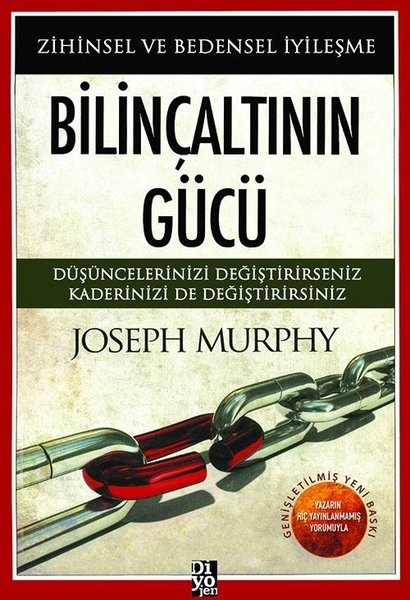 . (If you have not read it, I strongly recommend that you do.)
The central idea of the book, unlike the Murphy’s Law we commonly know, is that a person’s thought patterns, beliefs, and mental images deeply affect their behaviour, decisions, and outcomes in life. In this approach, a person’s inner world is like a garden in which seeds are planted. Whatever a person plants in the mind, they eventually harvest through their behaviour and life experience. The book’s table of contents includes chapters such as “How the Mind Works”, “The Miracle-Working Power of Your Subconscious Mind”, “Your Subconscious as a Partner in Success”, and “How to Use Your Subconscious Mind to Remove Fear”, all of which clearly reflect this core approach.
However, I should add something here: people are, in fact, already applying this idea either consciously or unconsciously. Depending on their beliefs, they call it prayer, karma, sending a message to the universe, and so on. But my own conclusion is this: most people do this by hoping. According to the book, however, what should really happen is not merely hoping, but believing that what you desire has already happened, imagining it as if it has already taken place, and allowing the subconscious mind to do its part. 😊 (I have given away the tip, but I still think you should read the book.) 😊
Murphy’s Law:
Edward Murphy, on the other hand, belongs to a completely different world: engineering, testing, aviation, space research, and safety-critical systems. His name is associated with the famous Murphy’s Law. The popular version everyone knows is this: “Anything that can go wrong will go wrong.” Although this sentence is often used in daily life as a humorous, fatalistic, or pessimistic expression, it carries a much deeper meaning in engineering.
I should also add this point: once this idea became popular through the press, many statements that Edward Murphy never actually said were later turned into so-called laws and labelled as “Murphy’s Laws.”
In reality, what the two Murphys describe are two different sides of the human condition. Joseph Murphy looks at the inner world of the human being, while Edward Murphy looks at the systems humans build in the external world. One represents mental programming; the other represents technical design. One says, “Start success in the mind.” The other says, “Accept the possibility of failure at the very beginning of the design process.” At first glance, they may seem contradictory. Yet when these two approaches are considered together, especially in high-safety fields such as aviation, a very powerful principle emerges:
The mind must remain positive, but the system must be designed paranoid.
This sentence summarises the core philosophy of modern aviation and, in general, all sectors that require high reliability.
Joseph Murphy: A Person First Wins or Loses in the Mind
In Joseph Murphy’s thinking, the subconscious mind is like a person’s deep automatic software. A person’s fears, self-confidence, habits, reactions, beliefs about themselves, and expectations for the future are shaped there. According to Murphy, thoughts that are repeatedly held in the conscious mind gradually become programs in the subconscious mind.
Today, we do not have to interpret this entirely through a mystical framework. In a more modern and practical language, we can read it like this:
A person develops attention according to what they constantly think about.
A person produces courage or hesitation according to what they believe.
A person takes action according to what they consider possible.
A person often gives up without even trying when they consider something impossible.
Therefore, the most valuable aspect of Joseph Murphy’s approach is that it teaches people to take their inner dialogue seriously. If a person constantly says to themselves, “I cannot do this”, “This will not work”, “I always leave things unfinished”, or “I will fail anyway”, they unconsciously build their behavioural system around those assumptions. They avoid risk, fail to notice opportunities, withdraw at the first obstacle, and sabotage themselves.
On the other hand, if a person trains their mind in a more constructive way, their behaviour begins to change as well. Sentences such as “I can build this step by step”, “Every day I can make small but concrete progress”, “When I make a mistake, I can strengthen my system”, and “Success is possible for me” are not merely romantic motivational phrases. When used correctly, they produce attention, determination, and behavioural continuity.
Joseph Murphy’s suggestions such as affirmation, visualisation, and mental preparation before sleep are also valuable from this perspective. When a person frequently visualises a goal in their mind, they are not merely daydreaming; they are giving direction to the brain. When an athlete mentally rehearses a competition, when a pilot visualises an emergency procedure, or when a technician mentally reviews a critical maintenance step, they are actually performing mental preparation. In this respect, Murphy’s approach to the subconscious overlaps with modern performance psychology at certain points.
However, there is an important boundary to observe here. Joseph Murphy’s language can sometimes sound overly miraculous and can seem to promise absolute results. It may be misunderstood as if everything in the external world can be changed simply by thinking. That would be a dangerous interpretation. In real life, thought alone is not enough. Thought must turn into behaviour. Behaviour must turn into a system. And the system must be tested, measured, and corrected.
This is exactly where the second Murphy enters the picture.
Edward Murphy: If Something Can Be Done Wrong, Someone Will Do It Wrong
Edward A. Murphy Jr. was an American aerospace engineer. The origin of Murphy’s Law goes back to a project related to high acceleration and deceleration tests conducted by the United States Air Force. In rocket sled tests designed to measure the human body’s tolerance to high G-forces, measurement systems and sensor connections played a critical role.
According to the famous story, during one of the tests, sensors or measurement connections were installed incorrectly. As a result, the expected data could not be obtained from the system. Edward Murphy, frustrated by the situation, made a statement meaning something like this:
“If there is a way to do a thing wrong, someone will do it that way.”
Over time, this sentence evolved in popular culture into “Anything that can go wrong will go wrong.” But the real engineering message behind it is far more valuable. Edward Murphy was not saying that the world is bad or that fate constantly works against human beings. The real message was this:
A system must be designed by accepting the fact that humans can make mistakes.
This approach is an extremely critical principle in aviation. Aviation does not claim that error can be completely eliminated. Instead, it accepts that errors can occur and builds barriers to prevent those errors from turning into accidents.
If a component can be installed backwards, then either it must be physically impossible to install it that way, or the system must immediately make the incorrect installation visible. If a critical step in a procedure can be forgotten, a checklist must come into play. If a technician can make a mistake due to fatigue at the end of a long shift, an independent inspection system must be established. If a pilot can make a wrong decision under heavy workload, cockpit design, alarm prioritisation, and CRM culture must take that possibility into account.
In this sense, Murphy’s Law is not pessimism; it is engineering humility.
Designing with Murphy in Aviation
In aviation, many systems are actually designed in the spirit of Edward Murphy. Because in aviation, “hopefully nothing will happen” is not a safety barrier. Hope, good intentions, experience, or self-confidence alone are never considered sufficient. In every critical operation, one question must be asked:
Where can this go wrong?
This question lies at the heart of aviation culture.
For example, the principle of fail-safe design aims to ensure that when a failure occurs, the system moves as much as possible toward a safe condition. When a component fails, it is unacceptable for the entire system to collapse in an uncontrolled way. The system must tolerate the failure or enter a safe mode.
Redundancy is also a direct result of Murphy thinking. Critical systems are duplicated or backed up so that a single failure does not lead to disaster. Hydraulic systems, electrical sources, navigation systems, flight control computers, and communication systems are usually not left dependent on a single point.
The checklist culture is the operational equivalent of the same logic. In aviation, the use of checklists is not due to the ignorance of pilots or technicians. On the contrary, it arises from the acceptance that human memory is limited. Even the most experienced person can become tired, distracted, interrupted, or skip a step because of routine. A checklist does not belittle the human being; it protects the human being.
In the world of maintenance, independent inspection or duplicate inspection practices are also clear examples of Murphy-oriented design. A critical connection, control surface, engine system, or safety-related task is not left solely to one person saying, “It is complete.” A second set of eyes, a second signature, and a second verification are required. Because the system accepts from the beginning that humans can make mistakes.
The discipline of human factors is born from the same way of thinking. Human error is not treated merely as bad intention or incompetence; it is treated as a reality that design must take into account. Fatigue, stress, shift patterns, communication breakdowns, authority gradients, false assumptions, confirmation bias, time pressure, and distraction are real risk factors in aviation.
In other words, Edward Murphy says the following in aviation:
“Humans will make mistakes. Therefore, build the system in such a way that the error is caught before it turns into an accident.”
What Happens When the Two Murphys Come Together?
The most interesting point is that Joseph Murphy and Edward Murphy are not opposites; they complement each other.
Joseph Murphy teaches us not to neglect the inner world of the human being. Motivation, self-confidence, mental preparation, positive suggestion, focus on goals, and coping with fear all belong to his side. Without this side, people cannot dare, cannot produce sustainable energy, and cannot remain calm in a crisis.
Edward Murphy teaches us not to romanticise the external world. Systems fail. People make mistakes. Sensors are connected incorrectly. Procedures are skipped. Software freezes. Power goes out. Data arrives incorrectly. Files disappear when backups have not been made. Untested systems fail in the field.
When these two approaches are used together, they create a powerful philosophy of management and design:
Motivate the human, but design the system with suspicion.
In a training programme, the Joseph Murphy side teaches a person to trust themselves, clarify their goal mentally, manage their fears, and develop positive inner dialogue. The Edward Murphy side teaches the same person to use checklists, perform risk analysis, think through failure scenarios, build fallback plans, and verify every critical step.
When these two sides are not combined, the system remains incomplete.
If we remain only on the Joseph Murphy side, there is a risk of excessive optimism. A person may say, “I can do this”, “It will work”, “The universe will support me”, or “My intention is good”, and ignore technical realities. This is dangerous, especially in fields such as aviation.
If we remain only on the Edward Murphy side, excessive fear and rigidity can emerge. A mind that doubts everything, takes no steps, and constantly thinks about disaster scenarios can kill productivity. The system may become safe, but it cannot move.
The correct balance is this:
Courage in the mind, caution in the system.
Murphy from the Perspective of Entrepreneurship, Technology, and the SLCN Mindset
This topic is not relevant only to aviation. It also applies to technology ventures, artificial intelligence systems, automation infrastructures, and digital platforms.
An entrepreneur needs the Joseph Murphy side. Carrying a big vision is not easy. A person sometimes has to struggle with lack of money, technical problems, uncertainty, fatigue, and the sceptical attitudes of others. In such moments, mental resilience, inner dialogue, keeping the goal alive in the mind, and the belief that “this can be built step by step” are very important.
But if the same entrepreneur neglects the Edward Murphy side, the system collapses under the first serious load. The server has not been backed up. SMTP settings have not been tested. Cron jobs are not running. Logs are not being kept. A user pays, but membership is not activated. Artificial intelligence answers using incorrect data. A translation plugin breaks SEO titles. Social media automation posts to the wrong account. The database grows, but there are no indexes. There is supposedly a backup, but restore has never been tested.
This is where Murphy’s Law becomes just as valid in the digital world as it is in aviation:
If there is a field that can be misunderstood, the user will misunderstand it.
If there is an integration that can break, it will break on the busiest day.
An untested backup is not a backup.
An unlogged error is an ignored error.
A manual process open to human error will eventually be done incorrectly.
A process dependent on a single person is not a scalable process.
That is why a good digital system must also be “Murphy by design.”
For example, in a publishing automation system, it is not enough to say, “The content has been produced.” The following questions must also be asked:
What happens if the content goes to the wrong category?
Does the system detect an incomplete translation?
Does it warn us if the Rank Math description is empty?
Does publishing stop if the image alt text is missing?
Does the system retry if social media sharing fails?
Is there a fallback if the API does not respond?
Does the system flag faulty data sources?
Is the legal disclaimer added to financial information shown to the user?
All of these belong to the Edward Murphy side. But the person who builds this system, sits at the desk every day, keeps going despite fatigue, does not lose morale after setbacks, and keeps the big picture alive in the mind belongs to the Joseph Murphy side.
The Two Murphys as an Educational Topic
This subject can become a very powerful module, especially in aviation training. The title could be:
“Murphy by Design: Thinking Before the Error Happens in Aviation”
An even stronger subtitle would be:
“Positive mind, paranoid system.”
In this training, the Joseph Murphy side could first be used to explain mental preparation: stress management, fear, self-confidence, staying calm in a crisis, mental rehearsal, and positive inner dialogue.
Then Edward Murphy could be used to explain the realistic side of aviation system design. The topic could be made concrete through examples such as fail-safe design, redundancy, checklists, duplicate inspection, maintenance error management, error chains in ramp operations, OCC/MCC decision processes, de-icing fluid selection, and time pressure.
Murphy’s Law is especially instructive in maintenance and ground operations. Because a small error on the ground can turn into a major consequence in the air. An incorrectly closed panel, a forgotten tool, insufficient torque, an incorrect load sheet, a faulty de-icing application, an incorrect fuel quantity, a wrong configuration, or a missing communication link can all become one link in the chain. Aviation safety aims to break those links before they turn into an accident.
That is why one of the most important sentences in aviation is this:
Hope is not a safety barrier.
A technician cannot say, “I hope I did it correctly.”
A pilot cannot say, “It is probably fine.”
A dispatcher cannot say, “I suppose there will be no problem.”
A ramp team cannot say, “The load is probably positioned correctly.”
An instructor cannot say, “They must have understood it.”
Every critical claim must be verified.
Joseph for the Human, Edward for the System
It is genuinely ironic that the two Murphys share the same surname. One places the human subconscious at the centre; the other places system failure possibilities at the centre. One tells us, “Prepare your mind for success.” The other tells us, “Prepare your system for the possibility of failure.”
When these two sentences are read together, they reveal a major lesson for life and engineering:
Make success possible in the mind, and make failure harmless in the system.
A good leader strengthens the team with the Joseph Murphy side and protects it with the Edward Murphy side.
A good engineer designs the system according to Edward Murphy, but needs Joseph Murphy’s mental resilience to finish the project.
A good aviation professional recognises the value of the human being, but never forgets that the human being is not flawless.
This is where the greatness of aviation culture lies. Aviation does not humiliate the human being, but it does not idolise the human being either. The human is valuable, trained, experienced, and responsible. But the human also gets tired, forgets, makes mistakes, misunderstands, and sometimes makes poor decisions under pressure. Therefore, a system must rely not on human good intentions, but on verifiable processes.
Joseph Murphy reminds us of the power of our inner world.
Edward Murphy reminds us of the harsh realities of the external world.
Without one, the other remains incomplete.
An aircraft does not fly by positive thinking alone.
But human beings cannot progress through paranoid engineering alone either.
The best formula is this:
Train the mind like Joseph Murphy.
Design the system like Edward Murphy.
Verify the result with aviation discipline.
The article turned out a little long, but I hope it will be useful…
Kind regards…